
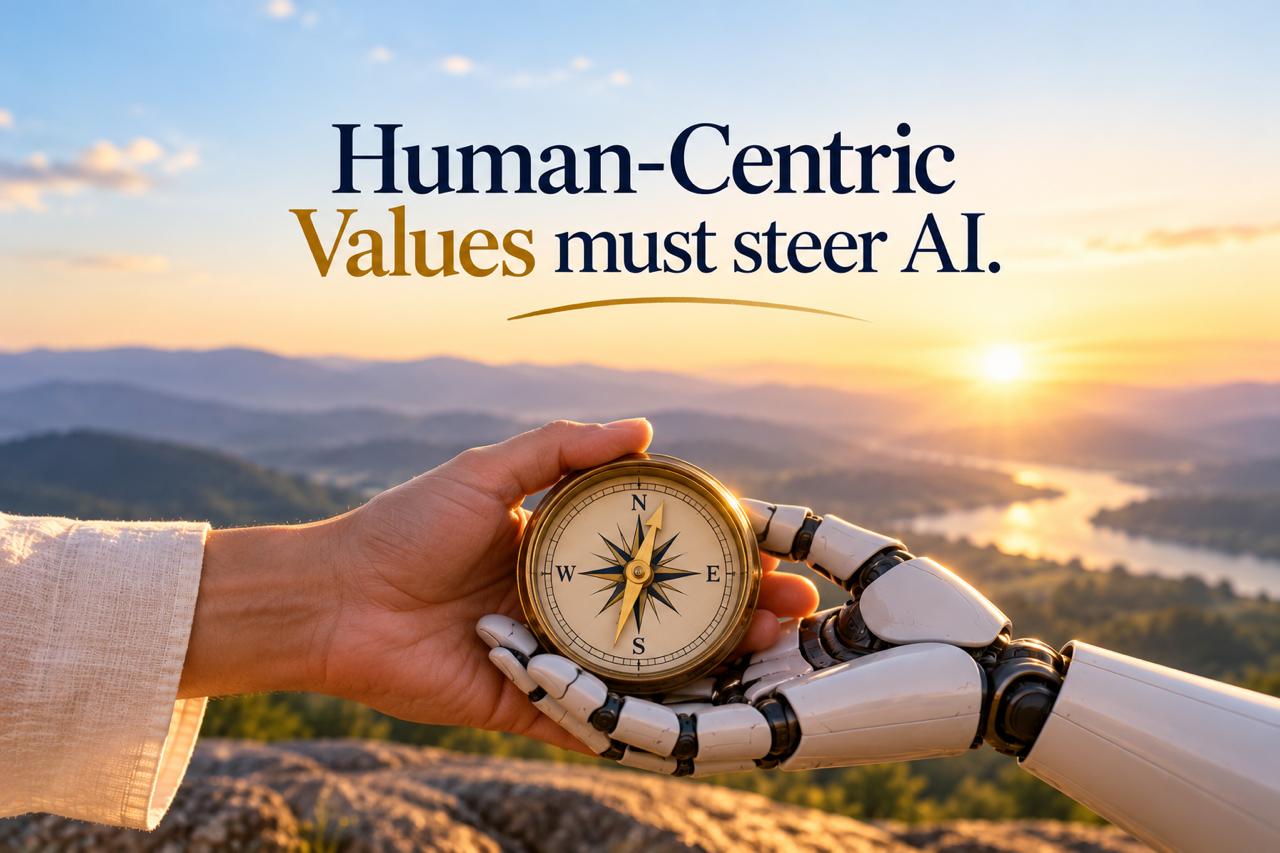
The elephant in the room
The debate about artificial intelligence has turned to guardrails, regulation and this month, religion. Each matter. None reaches the question underneath them all: will the people who build these systems keep the human being at the centre?
Machines do not choose their purpose. People do. Every model is trained, deployed and governed by engineers, executives and regulators, each making thousands of small decisions under pressure. Whether AI elevates humanity or merely automates it will be settled less in the code than in the character of those people.
That is the elephant in the room. We are building the most capable technology in human history, and we have given far less thought to forming the humans who will direct it.
Why guardrails are not enough
The leading AI companies are growing at a pace no industry has seen. Their leaders speak openly of risk, and some have called for the industry to slow down. Laboratories now test their systems, publish safety policies and invite outside evaluators. All of this is welcome.
But guardrails share one weakness. They are set by people, maintained by people and, under pressure, loosened by people. Firewalls are breached. Rules are gamed. A safety commitment rests in the end on a board decision, and boards change. Competitive pressure has a way of overwhelming good intentions at the top.
Regulation sets a floor, never a ceiling. It tells us what we may not do. It cannot tell an engineer at two in the morning, with a deadline the next day, what she ought to do. Only her own judgement can, and judgement is formed long before anyone writes a line of code.
Shaswat: values that outlive civilisations
Where, then, are the values to come from? Not from any one company, nation or faith. They must come from what humanity has already tested over thousands of years.
India’s rishis set down a verse many of us recited at school assemblies:
“Sarve Bhavantu Sukhinah, Sarve Santu Niramayah. ….” May all be happy. May all be free from illness….
Where is the religion in this? It names no god and asks no belief. It asks one question of any undertaking: does this serve the wellbeing of all, or only of some?
In Bharat we call such principles Shaswat: enduring, and belonging to no single community. The rishis were not founding a creed. They were recording what generations had learned about how human beings may live well together. Empires have risen and fallen since. Those values have stayed.
So, when a leading AI executive warns against bringing religion into AI, he is right that no machine should carry religious authority, and that human judgement must never be surrendered to one. But consulting this inheritance is the opposite of surrendering judgement. It is how judgement is formed.
Where values are formed: school, not lectures
Values cannot be installed in adulthood like a software update. They are formed in childhood, when conscience and character take shape. The engineers, regulators and chief executives who will govern AI in 2040 are in classrooms today.
Yet we will not form them with another subject on the timetable. A moral science period on Friday afternoon teaches children that ethics is a separate topic, examined once and then set aside. Values are caught more than taught.
They are absorbed in daily life: on the walk to class, in the classroom, in the dormitory and at the dining table. They show in how the older boy treats the younger, how the teacher answers an awkward question, how a mistake is owned. A boarding school, where children live their values around the clock, is perhaps the strongest setting there is for this kind of formation.
At the centre of it stands the teacher. When machines can deliver any fact in seconds, the teacher’s work does not shrink. It changes. No longer the source of information, the teacher becomes the former of conscience and the builder of questions. The technology world speaks of keeping a human in the loop. We must keep the guru in the loop.
Use the technology, do not stop it
None of this is an argument for slowing innovation. It is an argument for directing it. Keeping AI human-centric is not done by fearing the technology. It is done by putting it in young hands and asking the right question of it.
The surest way to form human-centric engineers is to let children build. Give them AI and robotics, then ask them to solve real human problems: clean water for a village, access to care for the elderly, early warning for farmers. They learn the technology in the act of serving someone. Ethics and engineering stop being two subjects and become one act.
There is no shortage of problems. The world remains far behind on the UN Sustainable Development Goals, with the 2030 deadline close. India has set out its own direction. At the India AI Impact Summit in February 2026, the Prime Minister described the M.A.N.A.V. Vision, manav meaning human: moral and ethical systems, accountable governance, national sovereignty over data, accessible and inclusive technology, and valid and legitimate systems.
That vision will hold only if the people who carry it out share its values. Policy can point the way. Character must walk it.
Not surviving a decade, but bettering humanity
The question before us is not whether humanity survives the next ten years of AI. It is whether humanity comes out of this century better than it went in.
That depends on whether the gains reach everyone. Gandhiji’s talisman asked us to recall the face of the poorest person we had seen, and to ask whether our next step would help them. It is the same test as Sarve Bhavantu Sukhinah, and the right one for every product launch. A technology that prospers some communities and leaves the last person in the line to fend for himself has failed, however clever it is.
Machines will keep growing more capable. Our task is to ensure that the young who will direct them grow ever more human-centric. The guardrail that matters most is not written in code. It is formed in a classroom, in a dining hall, on the walk to class, every day.
Humanity is not a slogan. It is a specification.
Deep Kapuria is the Chairman of The Hi-Tech Group of Companies comprising The Hi-Tech Gears, The Hi-Tech Engineering Systems, The Hi-Tech e-Soft, and Novus Hi-Tech Robotic Systemz. The Group has manufacturing, R&D and engineering facilities in India, Canada and USA. He is also the Past Co-Chair of Digital Economy and Industry 4.0 Task Force of B20, 2018 Argentina, Past Co-Chairman, CII National Committee on International Trade & Trade Policy, and Past Chairman of NABCB, a constituent of Quality Council of India.


