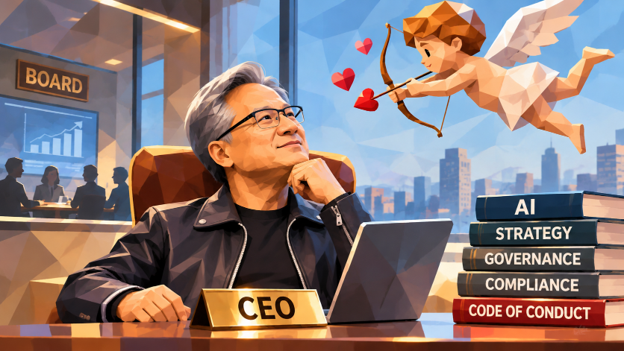
When corporate titans lose their hearts, their heads & occasionally their jobs.
There was a time when the greatest threat to a corporate CEO was a hostile takeover, disappointing quarterly results or an activist shareholder. Today, an equally formidable threat appears to be Cupid, that mischievous little fellow who has never attended business school, understands nothing about corporate governance & has a remarkable ability to bring powerful men to their knees.
The latest casualty is Jensen Huang, the legendary architect of Nvidia’s extraordinary rise, who has resigned amid revelations about his personal relationships. The controversy has even acquired an international espionage dimension, with allegations involving a woman suspected by US authorities of links to Chinese intelligence. Those suspicions remain unproven, and Nvidia has said it has no reason to believe its secrets were compromised.
Imagine the irony. A man who helped create the world’s most sophisticated AI computing infrastructure finds himself confronting a problem for which neither artificial intelligence nor a trillion dollar valuation offers much protection. Perhaps Nvidia’s next breakthrough should be a chip that improves human judgment, particularly when the heart starts overruling the brain.
From Fast Food to Fast Romance
Huang is hardly the first corporate titan to discover that romance & corporate governance make uncomfortable bedfellows.
Remember Steve Easterbrook, the former CEO of McDonald’s? He lost his job in 2019 following a relationship with an employee that violated company policy. Subsequent investigations revealed additional relationships & misleading disclosures, eventually drawing the attention of America’s Securities & Exchange Commission.
Apparently, even the man running the world’s most recognisable fast food chain could not resist an occasional extra helping of romance.
Then came Bernard Looney, CEO of BP, who resigned in 2023 after acknowledging that he had not been fully transparent about past relationships with colleagues. BP subsequently determined that he had misled the board.
For an oil industry executive accustomed to managing volatile energy markets, it was an unfortunate failure to manage his own combustible affairs.
And in 2025, Nestlé dismissed CEO Laurent Freixe following an investigation into an undisclosed relationship with a direct subordinate that breached its code of conduct.
One might have expected the company behind KitKat to understand the importance of taking a break. Apparently, the CEO took the concept rather personally.
Three different industries. Three accomplished executives. One recurring lesson.
Cupid, it seems, is remarkably sector agnostic.
The Boardroom’s Blind Spot
What makes these episodes particularly fascinating is the elaborate machinery of corporate governance surrounding modern enterprises.
Companies have audit committees, risk committees, remuneration committees, nomination committees & independent directors. There are compliance manuals thick enough to discourage even the most determined reader.
A junior manager may need multiple approvals to entertain a customer over dinner. Yet the person at the top can sometimes create an extraordinary governance crisis over dinner with someone who isn’t a customer at all.
And the board, which meticulously monitors capital expenditure, cybersecurity & geopolitical risks, suddenly discovers an entirely new category of exposure.
Perhaps the next annual report should include a section titled Matters of the Heart: Contingent Liabilities.
The real issue, of course, is not whether executives are entitled to private lives. They certainly are.
It is whether personal relationships interfere with professional judgment, create conflicts of interest or compromise the fairness on which an organisation depends.
When the CEO falls in love with someone who reports to him, the corporate hierarchy becomes rather more complicated than the organisational chart suggests.
An enthusiastic performance appraisal may invite suspicion. A promotion may raise eyebrows. And a disagreement, ordinarily resolved over a cup of coffee, could suddenly require an independent investigation.
Human Resources, meanwhile, must wonder whether the relationship belongs under employee engagement or risk management.
The Curious Privileges of Power
There is something about extraordinary corporate success that occasionally encourages extraordinary personal confidence.
A founder who has defied conventional wisdom, conquered markets & created enormous wealth may begin to believe that his judgment is infallible.
After all, if one can outsmart competitors, investors, regulators & technological disruption, how difficult can it be to manage a discreet personal relationship?
As it turns out, rather difficult.
The greater the power, the more complicated the question of genuine consent becomes. A relationship between colleagues of comparable standing is quite different from one in which a person’s career may depend upon the other’s goodwill.
And then there is the familiar corporate paradox. The very leaders who lecture employees on transparency, integrity & accountability sometimes discover that these admirable virtues are considerably more demanding when applied to themselves.
Perhaps the annual leadership retreat should include a new session: Practising What We Preach. Attendance compulsory. Especially for the CEO.
The Uninvited Stakeholders
While the corporate world worries about reputational damage, share prices & succession planning, there are other stakeholders whose interests seldom feature in board presentations.
Spouses, children & families.
They neither participate in executive compensation committees nor receive stock options, yet they may end up paying the highest price.
The company can appoint an interim CEO within hours. The communications department can issue a carefully worded statement. Lawyers can negotiate settlements, & investors can adjust their portfolios.
But personal trust does not come with a restructuring plan.
There is no EBITDA adjustment for emotional distress, no insurance policy against embarrassment & certainly no quarterly guidance on rebuilding a marriage.
The consequences of a moment’s indiscretion can last considerably longer than the CEO’s tenure.
Can AI Save the CEO From Himself?
Here lies perhaps the greatest irony of our technological age.
We are developing machines capable of analysing billions of variables, predicting consumer preferences, detecting fraud & anticipating market movements.
Could we perhaps develop an AI assistant that quietly whispers into the CEO’s ear:
“Sir, this particular meeting may have consequences beyond the quarterly results.”
Or an algorithm that flashes a warning when a supposedly routine business dinner starts extending into the early hours?
One can imagine the next generation of corporate dashboards displaying revenue, margins, return on capital & a new indicator: Romantic Risk Exposure.
But that would be taking corporate surveillance to absurd & dangerous lengths.
The solution cannot be to have artificial intelligence policing human affection. That would be an invasion of privacy far worse than the problem it seeks to address. Technology can strengthen governance. It cannot substitute for character.
A Little Wisdom, Without the Sermon
Our ancient Indian thinkers recognised four legitimate pursuits of life, including Kama, the pursuit of love & pleasure, alongside Dharma, the responsibility to act with integrity.
They understood something that even the most sophisticated corporate governance manuals occasionally overlook.
Human desires are natural. The wisdom lies in knowing how to exercise them responsibly.
Perhaps that is the one lesson worth adding to executive education, preferably before the next leadership conference at an exotic resort.
Ultimately, the issue is not whether CEOs should be permitted to fall in love. They are human, after all, however stratospheric their compensation packages.
It is whether they recognise that power carries responsibilities extending well beyond the balance sheet.
Boards need not become moral policemen. Nor should private lives become public entertainment. But when personal choices affect professional fairness, corporate security or institutional trust, accountability cannot be optional.
And as we race towards an age of artificial general intelligence, perhaps we should devote a little attention to cultivating something more fundamental: ordinary human wisdom. For all our technological brilliance, we have yet to invent an algorithm that reliably prevents intelligent people from doing remarkably foolish things.
Cupid may be blind. But surely the CEO & Board need not be.
(Author: Deep Kapuria, Chairman, The Hi-Tech Group, GITA, Former Chair NABCB)