
Why the leaders gathering in Delhi should look past regulation, to the formation of the people who will build what comes next.
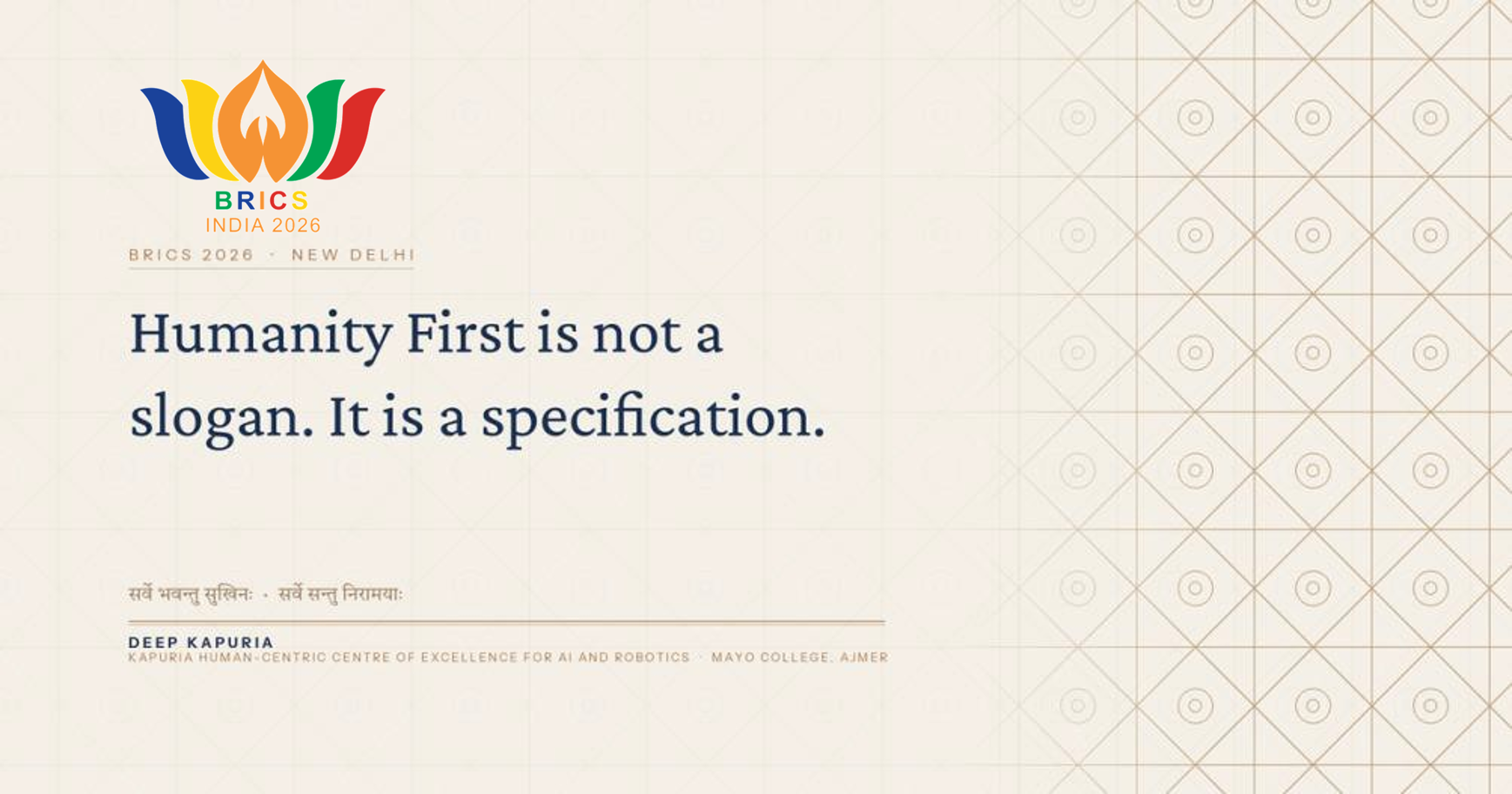
This week Delhi receives the leaders of the BRICS nations and their partners, in the twentieth year of the grouping and the fourth Indian Chairship. India has chosen its theme well. Building for Resilience, Innovation, Cooperation and Sustainability. And beneath that theme sits a phrase drawn from the Prime Minister’s own framing that I would ask every delegate to take more seriously than a summit slogan is usually taken.
Humanity First.
I want to argue that for the technology now arriving, Humanity First is not a courtesy. It is a specification. And unless it is treated as one, it will not be met.
What has actually changed
For most of my working life, the phrase artificial intelligence described an ambition. It now describes an industry that is improving itself. Systems contribute materially to their own advancement, which means progress compounds rather than merely accumulates. This is no longer a forecast about a later decade. It is a description of this one.
What should concern us is not any single capability. It is the character of the commentary from the people building these systems. They are among the most candid in the world about the possibility of severe outcomes. They continue to build, and they are not wrong that abstention by the conscientious would simply hand the field to the less conscientious. But their candour deserves to be heard for what it is. It is an admission that nobody currently possesses a proof of safety.
In earlier moments of technological gravity, such a proof was eventually produced, and the risk narrowed each time it was examined. There is no equivalent here. We are building at scale in advance of understanding.
The reflex, and why it is not enough
The instinctive response of every summit and every parliament is to reach for rules. I want to be careful here, because this is exactly where the argument is usually lost.
I am not saying do not regulate. I have spent enough years in policy rooms, including as Co-Chair for the Digital Economy and Industry 4.0 at the B20, to know that good rules save lives, that they set the floor beneath which no competitor may go, and that they give conscientious builders protection against the commercial pressure to cut corners. Regulate. Regulate more than we currently do.
But understand what regulation can and cannot reach.
Rules lag. Legislation describes the technology within the drafting committee’s experience, and is enacted into a world that has already moved past it.
Rules stop at borders. Capability does not. A restriction faithfully observed in Delhi becomes a commercial invitation somewhere else.
Rules govern only the declared. They can compel a disclosure, an audit, an impact assessment. They cannot reach the judgement made quietly at two in the morning by an engineer who alone understands what a system is doing, and who alone will decide whether to mention it.
Regulation sets a floor. It never sets a ceiling. The question that should occupy this summit is what fills the distance between the two.
Every guardrail is an artefact
Consider what a guardrail actually is.
Somebody decided where to place it. Somebody decided what it would refuse and what it would permit, what counted as harm, and whose harm counted. A guardrail is not a law of nature. It is a moral judgement rendered in code by a person whose own formation produced that judgement.
This has lately become easy to demonstrate. The most capable systems are now released in paired form, one version carrying additional safeguards in sensitive domains and one without. The underlying intelligence is identical. The entire difference between the helpful and the hazardous lies in constraints chosen and applied by people.
So the safety of the machine is downstream of the character of the maker. There is no degree of technical sophistication at which this stops being true. The more capable the system, the more consequential the maker’s character becomes.
That is the whole argument. Everything else is detail.
The arithmetic that makes this urgent
Until recently I would have called this important. I now call it urgent, and the case rests on arithmetic rather than prophecy.
A child in school today reaches the height of professional responsibility in the 2040s. That is the cohort which will occupy the rooms where these decisions are taken. Whatever they carry into those rooms will have been formed long beforehand, in classrooms and assemblies, in the example of their teachers, and in what the institution around them treated as admirable.
Character cannot be installed at the point of need. Its lead time is roughly fifteen years and it cannot be compressed. If we begin formation only when the technology arrives, we begin a generation late.
That is why this cannot wait. Not because a date has been set, but because the one intervention that reliably works has a longer lead time than the circumstance it must meet.
What India can offer, stated carefully
Here I come to the reason for writing this in Delhi, this week. And I want to state it carefully, because it is easily misheard.
India is the only major power that is simultaneously a producer of frontier technology and the custodian of a continuous ethical inheritance several thousand years old. That is an unusual position. It does not make our inheritance superior to anyone else’s. It makes us unusually well placed to convene, which is what a chair is for.
There is a reason for saying this here rather than somewhere else. The technology under discussion is roughly eighty years old. The question it raises, how power should be held by those who happen to possess it, is at least four thousand. Delegations this week arrive in a country that has been putting that question aloud, in a language still spoken and still taught, for the whole of that time. Not the only place to have asked it. But among the very few that never stopped asking.
Sarve Bhavantu Sukhinah, Sarve Santu Niramayah. May all be happy, may all be free from illness. That is India’s formulation. I do not offer it as religious doctrine and it should not be received as any. I offer it as one civilisation’s expression of something that many civilisations reached independently and without contact.
Egypt gave the world Maat, order and truth as the standard against which a life was finally weighed. The Iranian plateau produced one of the earliest systematic accounts of truth set against falsehood. The Confucian tradition arrived at ren, humaneness as the ground of right conduct. The African understanding of ubuntu holds that a person becomes a person only through other persons. The Islamic tradition holds amanah, trust, as the condition on which authority is held at all. Greek philosophy reached practical wisdom as the prerequisite of right action. In our own century the Universal Declaration asserted inherent dignity, and the Sustainable Development Goals translated it into obligations that can be measured.
Look at who is in the room in Delhi. Every one of those traditions is represented. That convergence is not a coincidence to be explained away. It is the closest thing humanity has to an empirical result in ethics, and it belongs to no single civilisation and to no religion.
For three thousand years it has been argued over, taught and passed from one person to the next without interruption. Most civilisations of comparable antiquity now transmit their ethics through archaeology. India still transmits them through teaching. The guru and the shishya are not a historical curiosity in this country. They remain a working method, and the delegates arriving this week are arriving somewhere that has never stopped practising it.
India’s contribution is not to impose a standard. It is to insist that this inheritance, the shared one, is admitted to a conversation that has so far been conducted almost entirely in the language of capability and compliance.
Guru in the Loop
The prevailing safeguard in system design is described as keeping a human in the loop, meaning a person retains authority over consequential decisions.
I want to propose a prior condition. Before there can usefully be a human in the loop, there must have been a guru in the loop. Because the reliability of the human depends entirely on who formed them.
Machines will deliver knowledge, and they will deliver it faster and more patiently than any teacher. What machines cannot do is form conscience. Conscience is transmitted by example, by relationship, by the sustained presence of an adult whose conduct a young person chooses to imitate. This is the irreducible work of the teacher, and it becomes more central rather than less as instruction is automated.
This is not offered as theory
I should say plainly where I am writing from, because an argument of this kind is worth less from someone who has not tested it.
At Mayo College in Ajmer, my old school, we have begun building a Centre of Excellence for Human-Centric AI and Robotics. It is early. It is not a finished thing, and I would mistrust anyone who told you otherwise at this stage. But its entire premise is the one set out above. The technology is taught alongside the formation of the person, on the understanding that the teacher becomes more important as the machine becomes more capable, not less.
We call the governing idea Guru in the Loop. The intention is not merely to produce students who are fluent with these systems, though they will be. It is to produce stewards. People who can be entrusted with capability because they were formed to carry it, and who will bring their own judgement and ingenuity to work where no rule will be present to supervise them.
A single school in Ajmer will not settle a global question. But the argument in this piece is either practicable or it is not, and the only honest way to find out is to attempt it somewhere, in the open, and report what happens. That is what we are doing. If it works it should be copied. If it does not, others deserve to know that too.
What I am asking
To the leaders gathering this week: put the formation of people on the agenda alongside compute, capital and capacity. It is the only input to this industry that cannot be procured at short notice.
To lawmakers: write your rules, and write more of them. But write them knowing they set a floor, and fund the layer above the floor with the same seriousness.
To the companies: your recruitment problem is not technical competence. That is abundant and getting cheaper. It is judgement under uncertainty, exercised without supervision, when the commercially convenient answer differs from the correct one. That is not produced by hiring. It is produced by formation, over years, in institutions that take it seriously.
And to educators, who carry the heaviest part of this: if conscience is formed by example, then your conduct is not adjacent to the curriculum. It is the curriculum.
Humanity First is the right theme. Let us treat it as a specification and hold ourselves to it
Deep Kapuria is Chairman of The Hi-Tech Group and founder of the Kapuria Human-Centric Centre of Excellence for AI and Robotics at Mayo College, Ajmer. He served as B20 Co-Chair for the Digital Economy and Industry 4.0 during Argentina G20.


